Until this autumn, the website for our annexe signed off by inviting you to “Book your stay with us”, and then gave you no way of doing so.
There was no button, no email address, no telephone number, not even a link to Booking.com, which is an awkward thing to admit for someone who has built more than 1,600 websites since 2001. It is the old story of the cobbler's children. Guests found us on Booking.com and booked there, which meant a commission on every stay: a fair price for the guests Booking.com found for us, and a rather galling one for those who would happily have booked with us directly, had we given them the means.
So I have at last built it a proper website, one that takes bookings and card payments on its own and keeps its calendar in step with Booking.com. It is our own place, but almost everything about it would work just as well for anyone else letting an annexe, a cottage or a shepherd's hut, which is really why I am writing it up.
| Client | Sam and me |
|---|---|
| The place | The Studio, a one-bedroom annexe at the bottom of our garden in Littleport, sleeping four, and open to guests since May 2024 |
| Platform | WordPress, with a theme built for it and a booking plugin I wrote to go with it |
| What I did | The copy, the design and the build, direct booking with card payments through Stripe, the calendar sync with Booking.com, and a What's On page that fills itself |
| The website | elyaccommodation.co.uk (opens in a new tab) |

Keep the listings, and give everyone else somewhere to book.
Booking.com and Airbnb are very good at what they do, which is putting your place in front of people who would never have found it otherwise, and I am not suggesting that anyone should leave them; we certainly have not.
What a website of your own does is give everyone else somewhere to book: guests who have stayed before and want to return, friends of friends, and people who searched Google for somewhere to stay near Ely rather than opening an app. None of them needed a booking site to find you, so there is no reason to pay one a commission when they book.
There is one rule worth knowing before you start. Under Booking.com's terms, a property in the United Kingdom cannot publish a lower price on its own website than it charges there, so The Studio costs the same either way, and the booking page says so. The difference is where the money goes, because nothing comes out of a direct booking except the card fee. What you can still do is email a returning guest a private code, because a private offer is not a published price, and the site has a box for those.
The calendar is the part that puts people off.
I suspect that what deters most hosts from taking their own bookings is not the website at all but the calendar. The moment you take bookings in two places, you can sell the same night twice, and nobody wants to be the one explaining that to a family standing on the drive with their suitcases.
Booking.com, Airbnb, Vrbo and most of the others already share a private calendar link and can read one back. It is an old and thoroughly unglamorous format called iCal, and it means your own website can keep in step with all of them without anybody copying dates across by hand.
The Studio's site reads Booking.com's calendar every 15 minutes, and reads it again at the moment a guest goes to pay, so it never takes money for a night that has just gone on Booking.com. It publishes a private calendar of its own in return, with no guest names in it, and Booking.com reads that, so a direct booking closes those nights over there too. If we want the place for ourselves, or someone books by telephone, I add it in WordPress and it goes out the same way.
A couple of quieter details do a good deal of the work. While someone is on the payment page, their nights are held for 35 minutes, so that two people cannot pay for the same weekend at once. And if Booking.com's calendar cannot be reached for some reason, the site carries on with the bookings it last knew about rather than assuming the nights are free, and emails me if that continues for more than a couple of hours.

There is one gap I cannot close from our end, and I would rather tell you about it than pretend it is not there. Booking.com and Airbnb read your calendar on their own timetable rather than yours, which can take a few hours, so for a short while after a direct booking they do not yet know about it. Every new booking email reminds me to close those dates on Booking.com by hand if I want them shut straight away. It is a quick job, and a great deal less trouble than keeping two diaries.
The Studio is only on Booking.com, so that is the one link it needs. If you are on Airbnb or Vrbo as well, their links go in the same box, one to a line, and you give each of them your site's calendar link in return.
Taking payment.
Guests pay in full by card when they book, on Stripe's own payment page, so their card details never pass through the website at all, and the confirmation arrives straight away. The price is worked out on the server rather than in the browser, and the page shows the full total, dogs included, before anybody gets as far as paying.
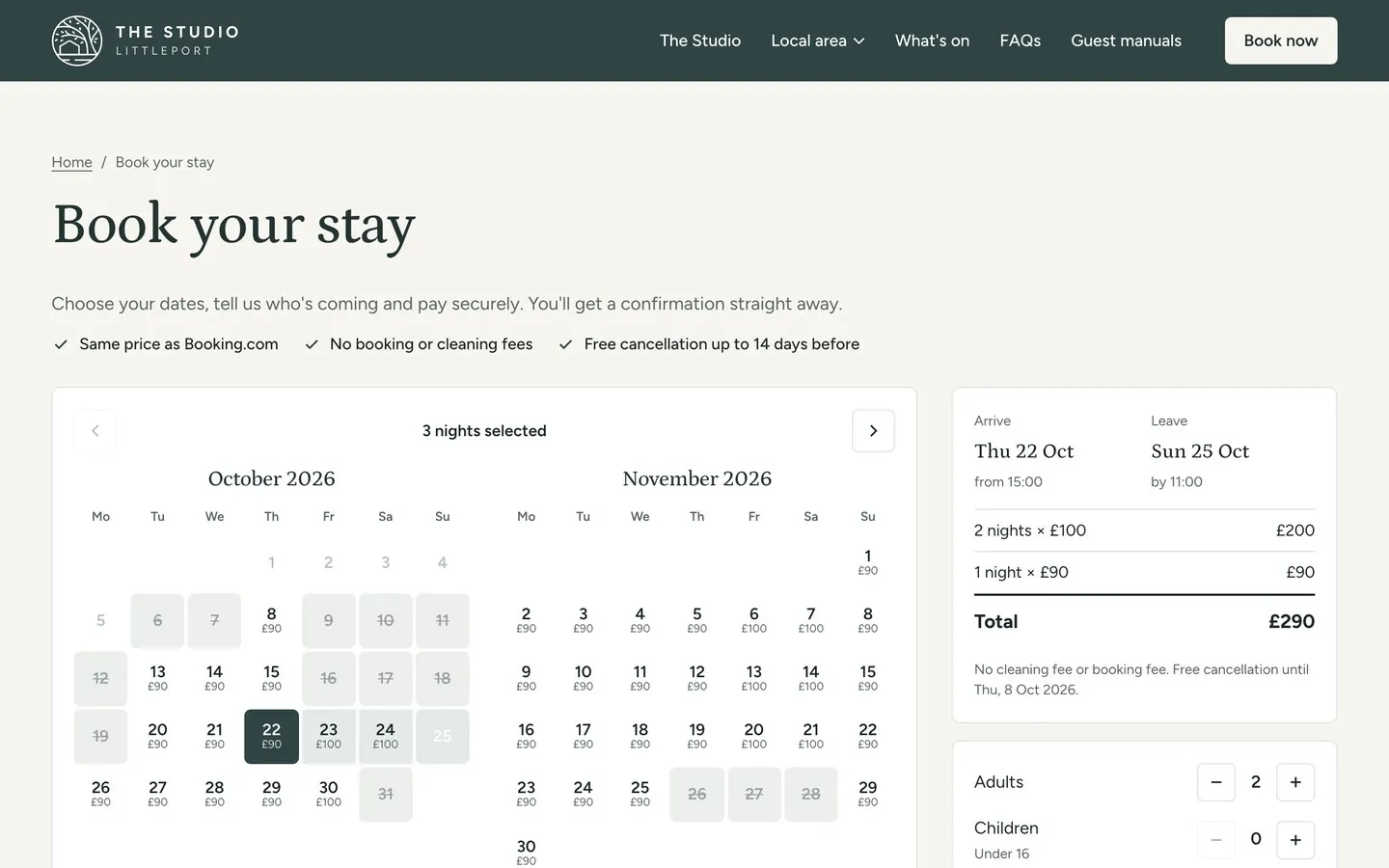
Two of the decisions were about how we actually live rather than about technology. You cannot book to arrive tonight, because we are not always at home to prepare the place, so the earliest arrival is tomorrow, and a host who needs more notice than that can set two or three days instead. And refunds are never automatic. Cancelling a booking in WordPress frees the dates and tells me whether a refund is due under our fourteen-day policy, but I press the button in Stripe myself, because a system that can hand money back on its own can also hand it back by mistake.
Answering the questions before they are asked.
A listing gives you a few boxes to fill in. A website gives you room to be properly useful, and to be frank with people about the things a listing tends to gloss over.
The FAQs (opens in a new tab) cover what people usually want to know before they book, and some of the answers are deliberately candid. The only way into the shower room is through the bedroom, for instance, so we say plainly that The Studio is not ideal for two couples who are not close. Far better that somebody reads that before they book than discovers it at ten o'clock at night.
The guest manuals (opens in a new tab) kept their old web address, because a printed QR code in The Studio points to it, and once a web address is printed on paper it is a promise. They cover the television, Sky Stream, the dishwasher, the air fryer, the radiators and the stove, so that a guest who cannot get the TV to work at nine in the evening can put it right without having to message us.
Then there is a What's On page (opens in a new tab) that fills itself. Once a month the site reads the listings that local organisers already publish on their own websites and turns them into one page, with pictures, sorted by month. Ely Cathedral, The Maltings, Ely Community Cinema, WWT Welney and Newmarket Racecourses are all in there, and the first run brought in 63 events. It uses only organisers who publish their listings in a form a computer can read reliably, so it will not fall over the first time one of them redesigns their website. Anything that is not right for our guests I can hide, and our own choices, such as the Littleport Show, can go in by hand.
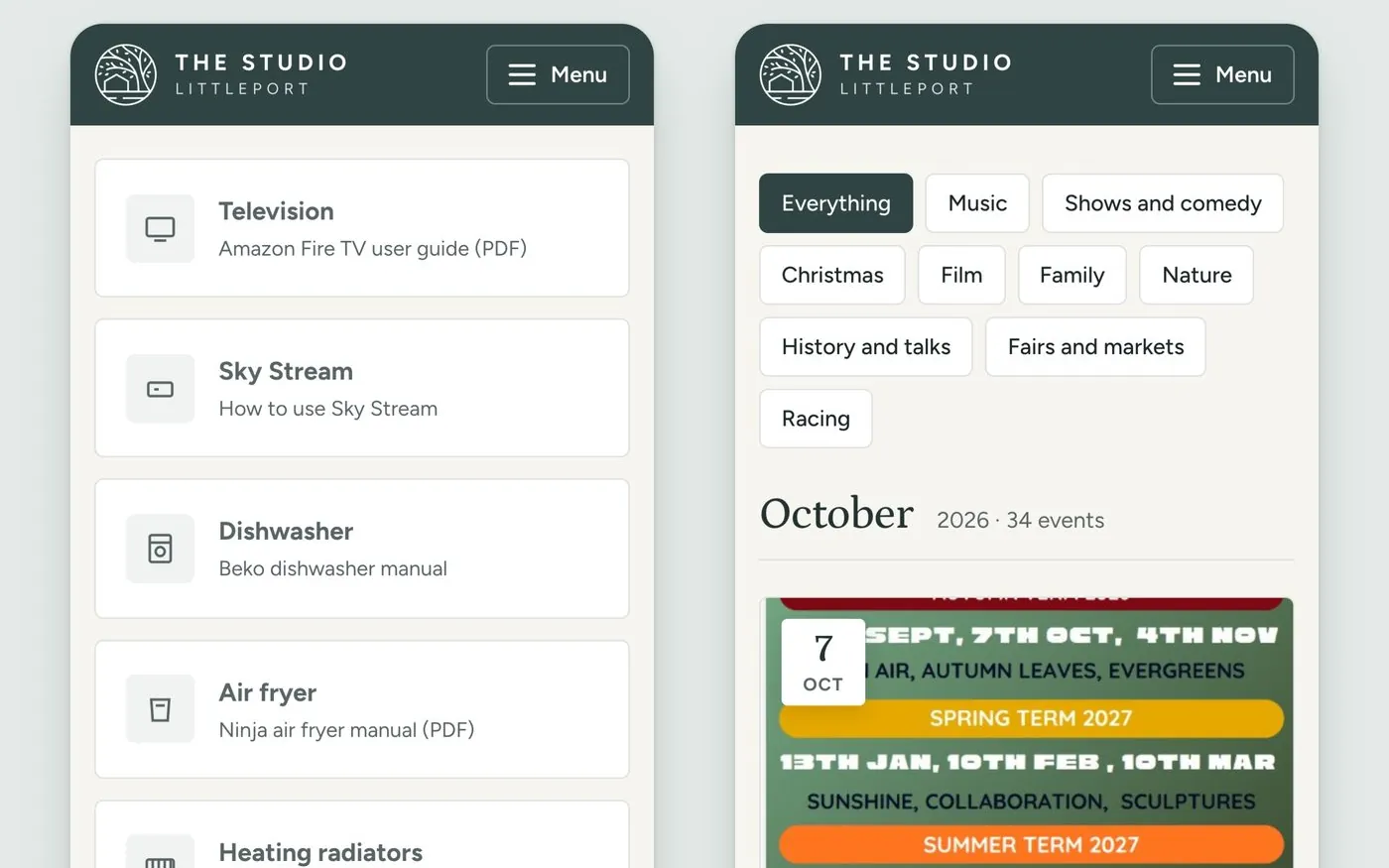
None of that is strictly about bookings, but it is the part of the site guests will use once they have booked, and it is how a place comes across as looked after before anybody has even arrived.
Who else this would suit.
Anyone with somewhere to let who is on Booking.com, Airbnb or Vrbo, and would like people to be able to book with them directly, could have the same. That might be an annexe like ours, a holiday cottage, a shepherd's hut or a flat above the shop. You keep your listings, because they are good at finding guests, and your website quietly takes the bookings that did not need finding.
You would need a Stripe account, which costs nothing to set up, and Stripe takes a small fee on each card payment, a fraction of what a booking site's commission would be. It is built for a single place to stay, so if you have several, it would be best to speak to me first, because each one needs its own calendar and that changes the build a little.
What I would take from this.
The website is the easy part. I think what stops most hosts taking bookings themselves is the worry about the calendar, and it is a reasonable worry, because a double booking is the one mistake a guest never forgets. Once the calendar is right, and you are honest about the small gap that remains, taking your own bookings stops feeling like a risk and becomes a fairly ordinary part of running the place.
Where it stands.
It is live at elyaccommodation.co.uk (opens in a new tab), still on WordPress, with a theme built for it in place of the old page builder, and every old web address kept, so nothing anybody had bookmarked or printed stopped working. Bookings and card payments are live, Booking.com's calendar is syncing, and What's On will keep filling itself every month.
If you let an annexe, a cottage or anything else that lives on Booking.com or Airbnb, I would be glad to hear about it, and I would build you the same, fitted to your place and your house rules. There is more on how I work with places to stay on the page about websites for holiday lets.