A website that helps people give, join and turn up.

Supporters want to know what you do, whom it helps and how to take part, and they decide quickly. I design, build and look after websites for charities, clubs and societies that answer all three plainly and make the next step easy, whether that is giving, joining or volunteering.

A proposal written for your trusteesThe same person throughoutA reply by the next working day

A silk bow tie and a pair of cufflinks in an open gift box, in black and white

Three things a supporter comes to do.

Each is shown on a client's website as it stands today.

Give.

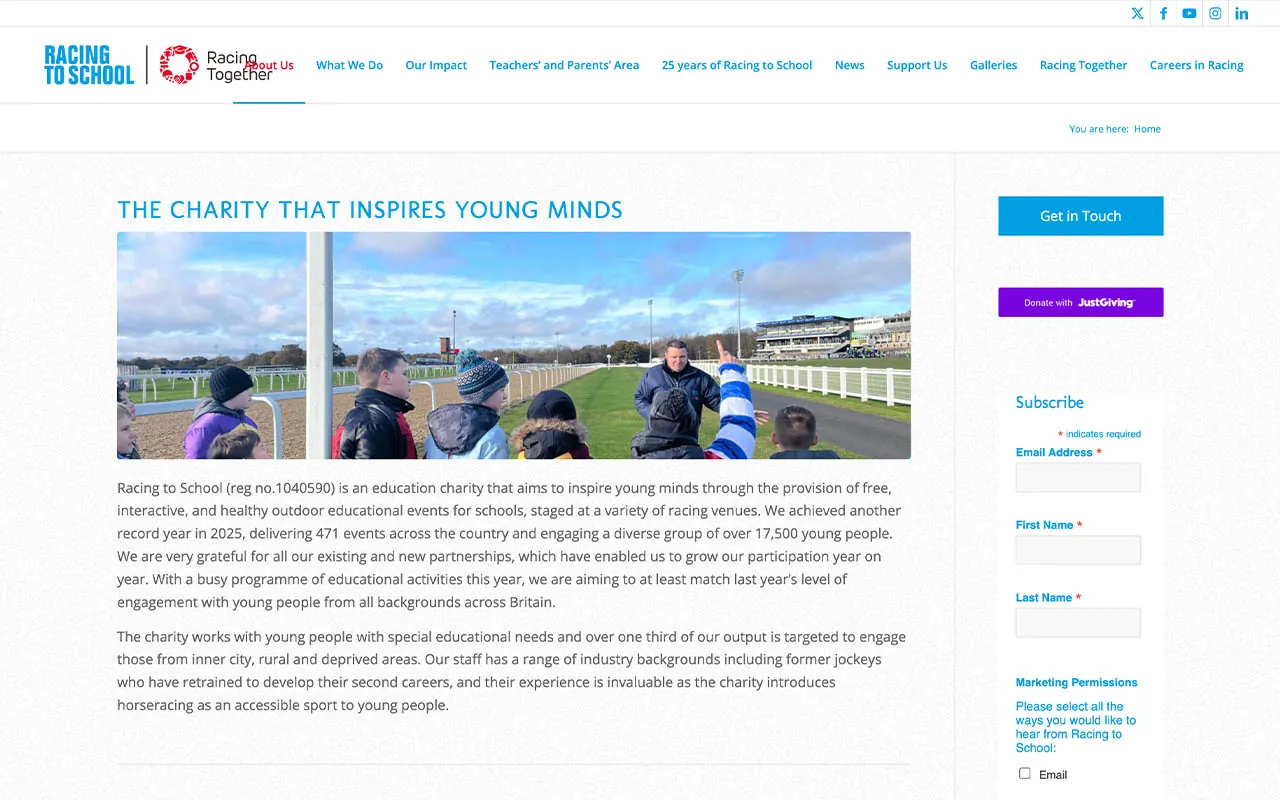
The donate button sits where it can be seen, on every page, and goes wherever you already take money. Racing to School, an education charity running free outdoor learning events for schools at racing venues, takes donations through JustGiving from the top of its homepage, beside the year it has just had: 471 events and over 17,500 young people in 2025, in its own words.

Prospects Trust, at Snakehall Farm in Reach, takes donations through LocalGiving from the Donate button at the end of its menu. Should you prefer to take card payments on your own website, they can be built in instead.

Visit Racing to School (opens in a new tab)
The Racing to School homepage on a phone, from its opening paragraphs down to the Schools' and Riders' programmes
The top of the Racing to School homepage: Get in Touch and Donate with JustGiving beside the paragraph that gives 471 events and over 17,500 young people in 2025
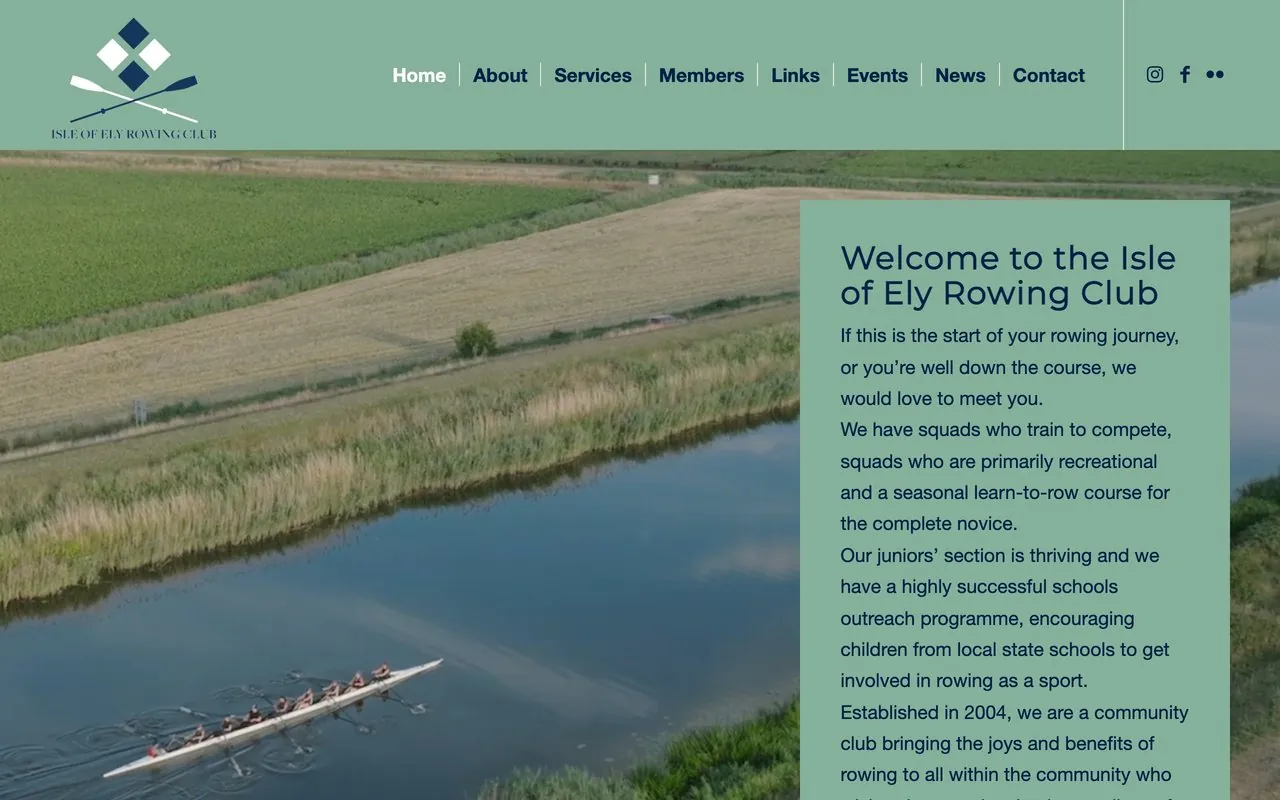
The Isle of Ely Rowing Club homepage, with Members, Events and News in the menu and the club's welcome beside an aerial photograph of a crew on the river

Join.

Members can join and renew online, with a members' area where it helps. Ely Rowing Club, a community club on the Great Ouse, keeps Members in its menu, with its juniors and its learn-to-row course in the welcome on the first screen.

The Surgical Research Society, a learned society active for more than 70 years, runs its memberships through its website, with Membership and Members Log In in the menu. The Tropical Agriculture Association International has Members Login and Become a Member on every page, with a membership system that I look after.

Visit Ely Rowing Club (opens in a new tab)

Turn up.

Events are set out so that people can find and book them. The Surgical Research Society sells the tickets for its Annual Meeting through its website and runs its Awards from there too, each under its own heading in the menu.

For Racing to School, turning up means a school arranging a visit, so the Teachers' and Parents' Area has its own place in the main menu. For a rowing club, it means Events, in the same menu bar as Members.

Visit the Surgical Research Society (opens in a new tab)
The Surgical Research Society homepage, with Annual Meeting, Membership, Council, Awards and Members Log In in the menu, above a photograph of a clinician in scrubs beside a microscope
“Adam listened carefully and understood the aims and values of SupplyFinder, and he then communicated those values through digital design.”
Lord JD WaverleySupplyFinder

A proposal your trustees can approve at their next meeting.

Committees need something in writing, and they meet to their own timetable, so the work is arranged around it. Nothing is owed until the proposal is signed.

  1. 1A 30-minute call

    The first call is free and takes place on Zoom, or in person if you are nearby. We talk about what the organisation does, whom the website is for, and the one thing you most want a visitor to do. Whoever will look after the website afterwards is welcome to join us.

  2. 2A written proposal within two working days

    The proposal sets out what is included, one fixed price and a launch date, in plain English and ready to go into the papers for the meeting.

  3. 3The decision, at your next meeting

    You take the proposal to the trustees, who may consider it for as long as they need before signing, with no obligation either way. Should the board have questions in the meantime, I answer them by email, no later than the end of the next working day.

  4. 4The build, in about four weeks

    I design and build the website, and you see it take shape and say what you think as it does, through short check-ins by email, with no portal to log in to. Larger projects are paid in three stages: a deposit, a payment on approval of the design, and the balance before launch.

  5. 5Live, and looked after

    The new website goes live on the web address you already have, and the old one is kept so that it can be put back at once should anything be wrong. From then on, should you wish, a care plan, monthly and rolling, keeps it fast, secure and backed up.

What trustees and volunteers ask.

These are the questions that arise when the person on the call answers to a board or a committee. If yours is not among them, you are welcome to send it to me, and I will answer it plainly.

How much does a charity website cost?

Every website is quoted to the job, because no two organisations need quite the same thing. The figure is fixed in the written proposal that follows the first call, and it holds however long the work takes; should the scope change, the new price is agreed in writing before any extra work begins.

What assurances can we give our trustees?

The assurances a board usually asks for are in place: professional indemnity insurance, references you are welcome to take up, and purchase order numbers with 30-day terms on request. You deal with me from the first call to the care afterwards. Every email is read and answered by me no later than the end of the next working day, and a trusted associate is on call for cover. At the end, everything is in the organisation's name: the domain, the hosting, the code and the accounts.

Will our staff and volunteers be able to update it?

Yes. Whatever it is built on, the website is set up so that adding news, events and photographs is safe for anyone. Whoever looks after it has a 30-minute walk-through at launch and a one-page guide to keep, and on a care plan, the changes you would rather not make yourselves are made by me, within the plan's allowance. Accessibility is part of the build rather than an extra: readable contrast, proper headings and forms that work with a keyboard.

Do you work with charities outside Cambridgeshire?

Yes. Most projects run remotely, with calls on Zoom, and I have clients across the United Kingdom. If you are nearby, I will come to you, or we can meet for a coffee in Ely, and the standard of the work is the same either way.

Tell me what you most want visitors to do.

You are welcome to book thirty minutes on a call, or to leave a note in the form about what the organisation does and whether you would most like visitors to give, join, book or volunteer, because that one choice shapes the whole website. If I can help, the proposal follows within two working days. If I am not the right fit, I will tell you so.

Or write to enquiries@adamlord.co.uk. For a fuller picture, the project brief takes about ten minutes.

Tell me about your organisation

Please add your name, so that I know who I am replying to.

That email address does not appear to be complete. Would you mind checking it?

Your message comes straight to me, and your details are used only to reply to it, never added to a list or passed on.

Thank you. Your message is with me.

It has come straight to me rather than to a queue, and I will reply by the end of the next working day.

Book a 30-minute call